The U.S. Dollar Is Losing Its Edge
The Dollar Is Still Dominant—but the Trend Is Changing
The U.S. dollar remains the world’s dominant reserve and trading currency. But investors are increasingly questioning whether its long-standing advantage is beginning to weaken.
The dollar index has been volatile in recent months, and on August 31 it stood around 99.5, after briefly falling below 99 earlier in the month. The latest moves have been heavily influenced by changing Federal Reserve expectations, inflation and geopolitical risks.
The important point is that “losing its edge” does not mean the dollar is about to lose its reserve-currency status. The bigger story is that some of its traditional advantages are facing greater scrutiny.
Global Reserve Managers Are Diversifying
U.S. Dollar Share of Global FX Reserves
The dollar’s share of global foreign-exchange reserves has declined substantially since 2000, although it remains the largest reserve currency.
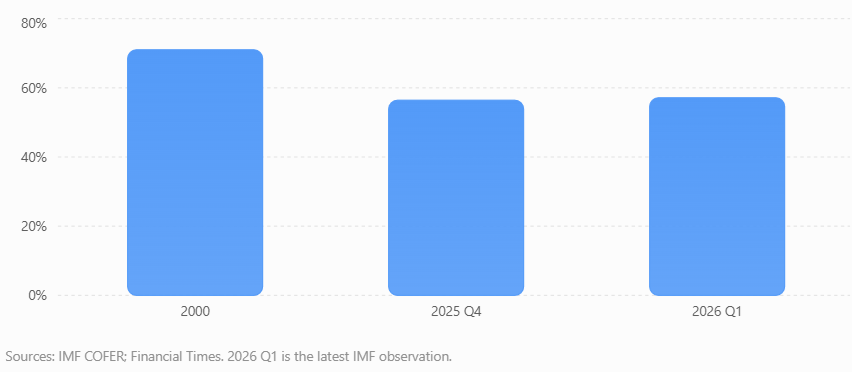
The dollar accounted for 57.13% of global foreign-exchange reserves in Q1 2026, according to the IMF, up from 56.42% in Q4 2025. That small quarterly increase is important because it shows the story is not a one-way decline.
But compared with roughly 71% in 2000, the dollar’s share is clearly lower.
Central banks are increasingly diversifying into other currencies and gold. That does not necessarily represent a wholesale rejection of the dollar—but it does suggest reserve managers are becoming more selective.
The Dollar Still Dominates Global Trade
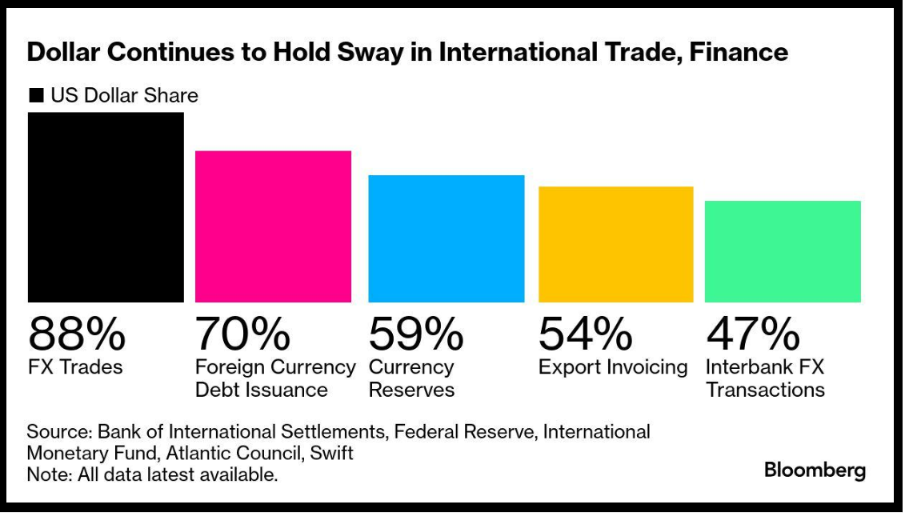
Despite the diversification trend, the dollar remains extremely difficult to replace.
The Bank for International Settlements found that the U.S. dollar was on one side of 89% of all foreign-exchange transactions in April 2025. Global FX trading averaged about $9.6 trillion per day during that month.
That enormous liquidity advantage gives the dollar a structural moat.
The euro lacks the same depth across global markets, while China’s renminbi remains constrained by capital controls. Other currencies simply do not have the scale to challenge the dollar on their own.
What Is Putting Pressure on the Dollar?
Several forces are working against the greenback.
1. U.S. Fiscal Concerns
Large government deficits and rising debt can make foreign investors question the long-term stability of U.S. finances.
This does not mean the U.S. is facing an imminent funding crisis. Rather, the concern is whether investors will demand a higher return to continue absorbing increasing amounts of U.S. debt.
2. Monetary Policy Uncertainty
The Federal Reserve has become another major driver of currency volatility.
On August 31, the dollar slipped slightly after recent hawkish comments from Fed Chair Kevin Warsh, while markets continued to debate the possibility of a September rate hike.
The result is a currency market highly sensitive to every inflation and employment release.
Geopolitics Is Becoming More Important
The dollar’s global role is also tied to U.S. geopolitical power.
Sanctions and the use of the dollar-based financial system as a policy tool have encouraged some countries to explore alternatives, including gold and other currencies.
But there is an important counterargument: the same geopolitical system that creates incentives to diversify also reinforces the dollar’s importance, because global investors still need deep, liquid and trusted financial markets.
The Dollar Has a Powerful Moat
The dollar’s biggest advantage isn’t simply America’s economic size.
It is the combination of:
- Deep and liquid capital markets
- Large supply of Treasury securities
- Strong global financial infrastructure
- Extensive use in international trade
- Dollar-based commodity markets
- Network effects
- Limited credible alternatives
The St. Louis Fed notes that dollar-denominated securities represented about 57% of global FX reserves, while the dollar remained the most widely used currency in international transactions.
That makes a sudden collapse in dollar dominance highly unlikely.
What Does a Weaker Dollar Mean for Investors?
A weaker dollar can create both winners and losers.
Potential beneficiaries include:
- U.S. multinational companies
- Commodity producers
- Emerging-market assets
- Gold
- Foreign equities
For American companies generating significant revenue overseas, a weaker dollar can also make foreign earnings worth more when converted back into dollars.
But a weaker currency can simultaneously increase the cost of imported goods and potentially add inflationary pressure.
The Real Question: Decline or Reset?
The most important distinction for investors is between de-dollarization and diversification.
The evidence currently supports diversification more strongly than outright de-dollarization.
The dollar’s reserve share has declined over the long term, but it still dominates global FX trading and remains far ahead of competing currencies. Even the latest IMF data showed its reserve share increasing modestly in Q1 2026.
So the more realistic scenario is not a sudden collapse of the dollar—but a gradual move toward a more diversified global monetary system.
Conclusion
The U.S. dollar is losing some of its historical edge, but it is not losing its global dominance.
Reserve managers are diversifying, fiscal concerns are increasing and geopolitical tensions are encouraging countries to reduce their dependence on U.S.-centric financial infrastructure.
Yet the dollar’s liquidity, market depth and network effects remain extraordinarily difficult to replicate.
For investors, the key takeaway is simple:
The dollar’s future may be less about losing its throne—and more about sharing it.