Canadian Household Debt: A Ticking Clock?
With debt-to-income ratios hitting record highs, over a million mortgages up for renewal, and wages struggling to keep pace, the financial pressure on Canadian households has never been greater.
The Debt Spiral: How Did We Get Here?
Canada’s household debt problem has been decades in the making. In 1980, Canadian households owed just 66 cents for every dollar of disposable income. Fast forward to Q4 2025, and that figure has ballooned to $1.77 — meaning Canadians now owe $1.77 for every single dollar they earn after tax.
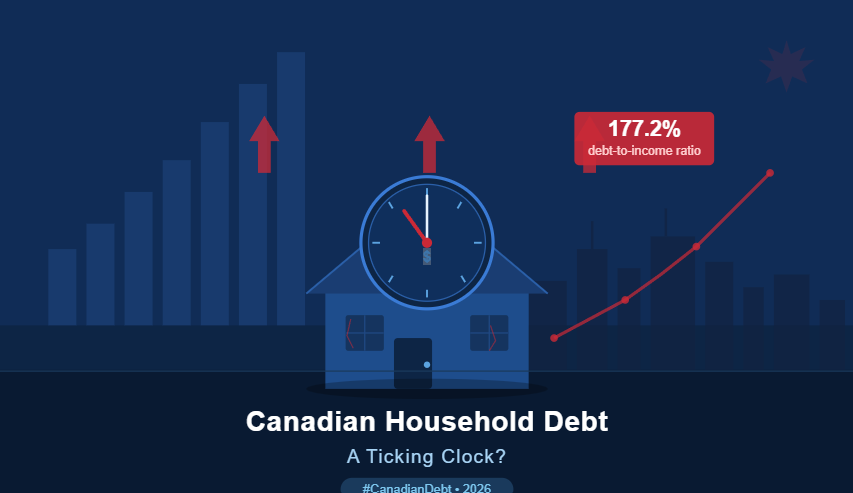
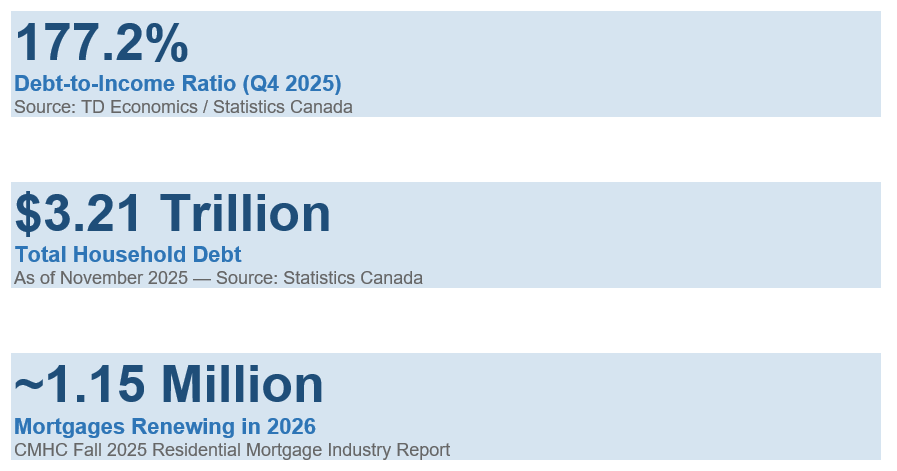
According to TD Economics, the household debt-to-income ratio rose to 177.2% in Q4 2025 — marking the fifth consecutive quarterly increase. Debt growth has consistently outpaced income growth, a trend that shows no signs of reversing in the near term.
“Beginning in 2011, Canada’s debt-to-income ratio surpassed that of the United States — and has continued to outpace the U.S. ever since.” — Statistics Canada
To put this in global perspective: even at the height of the 2007 U.S. housing bubble — which triggered a global financial crisis — American households peaked at a debt-to-income ratio of around 170%. Canada has now surpassed that level, and the mortgage renewal wave of 2025–2026 is poised to make things considerably worse.
The Mortgage Renewal Shock
Perhaps the most urgent pressure point in 2026 is the mass mortgage renewal cycle currently underway. Roughly 1.15 million Canadian households are renewing their mortgages this year, according to the Canada Mortgage and Housing Corporation (CMHC). The majority of these homeowners locked in five-year fixed mortgages during the pandemic era of 2020–2021, when the Bank of Canada slashed its benchmark rate to a historic low of 0.25% and five-year fixed rates fell below 1.5%.
Those loans are now maturing in a very different environment. Five-year fixed renewers face average payment hikes of 15% to 20% compared to December 2024 levels, according to Bank of Canada analysis. To put it in concrete terms: a homeowner with a $500,000 mortgage moving from a 2% pandemic-era rate to a 4% renewal rate will see their monthly payment jump by approximately $320. On a $400,000 mortgage shifting from 2% to 4.5%, the increase can approach $600 per month — over $7,200 per year.
A TD survey cited by CTV News found that 67% of homeowners feel uneasy about their upcoming renewal, and 56% have already begun cutting household spending to absorb the expected higher payments.
“Renewal shock isn’t a forecast — it’s already hitting Canadian households right now.” — Lendworth, January 2026
The CMHC’s data shows that mortgage arrears are expected to keep rising moderately across Canada from late 2025 into late 2026, with vulnerability concentrated in high-priced markets like Toronto and Vancouver. In Toronto, a weakening labour market compounds the financial strain, while Vancouver faces pressure from elevated debt levels and softening resale conditions.
Who Is Most Vulnerable?
The debt crisis is not hitting all Canadians equally. The data reveals clear fault lines by age, income, and geography.
By Age Group:
- Households aged 35–44 carry the highest debt-to-income ratio of any age group — a staggering 245.4% in Q3 2025 — reflecting the financial burden of purchasing homes at or near peak prices.
- Younger households (under 35) face a debt service ratio of 10.5%, meaning more than a dime of every dollar earned goes purely toward interest payments — with little progress on principal.
- Older households (55+) are paradoxically increasing their mortgage debt at a faster pace than younger groups, possibly taking on new debt to help children enter the housing market or purchase investment properties.
By Income:
- The income gap widened in 2025 — the difference in disposable income share between the top 40% and bottom 40% of earners reached 46.7 percentage points.
- Lower-income households were disproportionately hurt by declining interest rates on savings, while receiving less benefit from equity market gains that boosted the wealthy.
- The wealthiest 20% of households account for nearly two-thirds (65.7%) of Canada’s total net worth, averaging $3.5 million per household. The bottom 40%, by contrast, average just $81,650.
By Region:
- Toronto: Most exposed due to high home prices, elevated debt loads, and a weakening labour market. Mortgage arrears are projected to continue rising through 2026.
- Vancouver: Elevated debt and softening resale conditions create growing financial pressure, though at a slower pace than Toronto.
- Montreal: Relatively stable — mortgage stress is driven more by consumer credit than housing market conditions.
- Prairie cities: Mixed outcomes. Calgary faces moderate risk; Edmonton is more vulnerable given labour market sensitivities.
The Illusion of Wealth
On the surface, Canadian household balance sheets look healthy. Net worth rose to $18.6 trillion in Q4 2025 — a ninth consecutive quarterly increase — driven largely by strong equity market performance. The average household has seen financial assets grow by nearly 10% over the past year.
But this headline number masks serious underlying fragility. Nearly all of the wealth gains are concentrated at the top of the income and wealth distribution. Real estate values — the primary store of wealth for middle-class Canadians — declined 0.4% in Q4 2025. Meanwhile, household debt continues to grow faster than income.
Household credit market debt to disposable income has risen for five consecutive quarters. Debt growth is persistently outpacing income gains.
The household debt-service ratio — the share of disposable income going toward debt payments — stands at 14.6%, meaning nearly 15 cents of every after-tax dollar is consumed by debt repayment before any other expenses are paid.
The Ripple Effects on the Broader Economy
When millions of households face higher mortgage payments simultaneously, the macroeconomic consequences extend well beyond personal finance. Consumer spending — which drives a substantial portion of Canadian GDP — is already showing early signs of contraction in interest-sensitive sectors including retail, home improvement, and automotive sales.
The Bank of Canada now finds itself in a difficult position: the economy needs stimulus, but inflation risks tied to energy prices and tariff pass-through make rate cuts politically fraught. As of May 2026, the overnight rate remains on hold at 2.25%, offering little relief to households at renewal.
Compounding the problem: early 2026 data from Statistics Canada shows that nearly one in five businesses plan to pass tariff-related cost increases on to customers — including nearly three in ten manufacturers. This means Canadian families may face higher prices on everyday goods at precisely the moment their mortgage payments are rising.
What Can Households Do?
For Canadians facing renewal or carrying high debt loads in 2026, financial experts recommend a proactive approach rather than waiting for macroeconomic conditions to improve.
- Shop your mortgage early: The first offer from your existing lender is rarely the best. Recent Equifax data shows 56% of mortgage holders plan to explore switching lenders at renewal. OSFI’s November 2024 rule change means switching lenders on a straight renewal no longer requires requalifying under the stress test for many borrowers.
- Avoid auto-renewal: Automatically renewing at posted rates is often the most expensive choice a homeowner can make.
- Consider amortization extension: Extending the amortization period can reduce monthly payments in the short term — though it increases total interest paid over time.
- Prioritize high-interest debt: Credit cards and lines of credit often carry rates of 19–22%. Aggressively paying these down frees up cash flow and improves your renewal negotiating position.
- Build an emergency fund: With 41% of Canadians reportedly within $200 of insolvency per month, even a modest 3-month emergency cushion provides critical financial resilience against job loss or unexpected expenses.
- Consolidate thoughtfully: Rolling credit card debt into a refinanced mortgage can save thousands annually — but only if the underlying spending behaviour changes.
Looking Ahead: Crisis or Correction?
The consensus among economists is that Canada’s household debt situation represents a serious structural vulnerability — but not necessarily an imminent systemic crisis, provided the labour market holds up.
Mortgage arrears, while rising, remain historically low by absolute standards. The federal stress test, which requires borrowers to qualify at rates significantly above their contract rate, has provided a meaningful buffer. And strong income growth in parts of the economy has helped some households stay afloat.
But the margin for error is narrowing. Economists caution that delinquencies often lag rate shocks by 12 to 24 months — meaning the full impact of the 2025–2026 renewal wave may not show up in the data until 2027 or beyond.
The real test will come not from the renewals themselves, but from what happens to the labour market. A significant increase in unemployment — particularly if job losses spread beyond younger and part-time workers — could rapidly transform a manageable adjustment into something far more disruptive.
“Canada’s national debt clock and the 2026 mortgage renewal wave are converging at a pivotal moment. The situation does not currently point to a systemic crisis — but the margin for error is narrower than in previous years.” — TalkInDebts.com, March 2026
For now, the clock is ticking. The question isn’t whether Canadian households are under financial pressure — they clearly are. The question is whether wages rise fast enough, unemployment stays low enough, and rate relief comes early enough to prevent that pressure from becoming a crisis.