The Fed’s Next Move vs. Hotter Jobs Data
A Surprise From the U.S. Labor Market
The Federal Reserve’s September decision just became much more complicated.
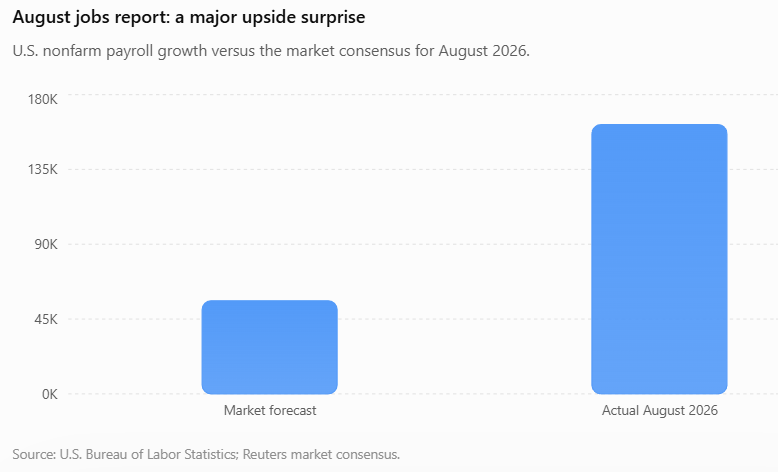
U.S. employers added 162,000 jobs in August, dramatically beating expectations of roughly 56,000. The unemployment rate remained at 4.1%, while the labor-force participation rate increased to 61.6%.
The report signals that the U.S. labor market may be considerably stronger than recent data had suggested.
For investors, the question is no longer simply whether the Fed can cut rates.
The bigger question is whether the Fed may need to raise them.
Jobs Growth Rebounded Sharply
August payroll growth was the strongest in five months and was almost three times the market forecast.
July payrolls were also revised significantly higher — from an initial -23,000 to +21,000. June was revised from +20,000 to +31,000.
Together, June and July employment was revised 55,000 higher than previously reported.
But the Labor Market Is Not Perfect
The headline number looks extremely strong, but investors should look underneath it.
Food services and drinking places added 59,000 jobs, while local-government education added 42,000. Manufacturing added another 16,000, and construction increased by 22,000.
Healthcare added 13,000 jobs, although that pace was slower than earlier months.
At the same time, the information industry lost jobs and several other major sectors showed little change.
This means the report is strong — but it does not necessarily represent a broad acceleration across every part of the economy.
The Inflation Problem Has Not Disappeared
This is where the jobs report becomes important for the Fed.
Average hourly earnings increased 0.3% in August and were up 3.1% year over year. Meanwhile, inflation remains above the Fed’s 2% target.
A strong labor market gives policymakers less reason to worry that higher interest rates will immediately trigger a major employment collapse.
That gives the Fed more room to prioritize inflation.
And that is exactly what makes a September rate hike a possibility.
The Fed Is Now Facing a Difficult Choice
Fed Governor Christopher Waller said on September 3 that he would favor holding rates if incoming inflation data show continued disinflation. But he also said a rate increase could be appropriate if the improvement proves temporary.
The Fed’s meeting is scheduled for September 15–16, just days after the August CPI report arrives on September 11.
So the decision will probably come down to two questions:
1. Is the labor market strong enough to tolerate higher rates?
2. Is inflation moving toward 2% quickly enough to justify waiting?
The jobs report makes the first question easier to answer.
The CPI will likely determine the second.
Markets Are Already Adjusting
Following the jobs release, expectations for a September rate hike increased. Reuters reported that market-implied odds rose from around 55% to 65%, while Treasury yields moved higher and the dollar strengthened.
The immediate market reaction was relatively contained, however. That suggests investors may already have been prepared for the possibility of tighter monetary policy.
For equities, the biggest risk is not necessarily one rate hike.
It is the possibility that investors have been too optimistic about future rate cuts.
What It Means for Investors
A stronger labor market combined with sticky inflation creates a difficult environment for rate-sensitive assets.
Potential pressure:
- Long-duration growth stocks
- Highly leveraged companies
- Commercial and residential real estate
- Small-cap companies dependent on cheap financing
- Long-duration Treasury bonds
Potential beneficiaries:
- Financial institutions
- Insurers
- Companies with strong cash flows
- Businesses with pricing power
- The U.S. dollar
The key variable is therefore not simply whether the Fed hikes.
It is how long rates remain elevated afterward.
The Bigger Investment Question
The August jobs report challenges the idea that the U.S. economy is rapidly losing momentum.
But one strong month does not erase the slower employment growth seen earlier in the year.
The BLS still reports that August’s 162,000 increase was well above the 31,000 average monthly gain over the previous 12 months.
That creates an interesting middle ground:
The labor market is stronger than feared, but not necessarily overheating.
If inflation remains stubborn, that may be enough for the Fed to raise rates.
If inflation cools sharply, policymakers could still choose to hold.
Risks
The biggest risks to this outlook are:
- Sticky inflation — could force the Fed toward tighter policy.
- Oil and energy prices — another inflation shock could complicate the Fed’s decision.
- Labor-market revisions — recent revisions show how quickly the employment picture can change.
- Consumer weakness — strong payrolls do not necessarily guarantee strong household spending.
- Policy uncertainty — trade and geopolitical developments could create new inflation or growth shocks.
Bottom Line
The August jobs report has shifted the Fed debate.
Instead of asking “When will the Fed cut rates?”, investors now have to seriously consider “Could the Fed raise rates again?”
The answer is still uncertain.
The next major test comes on September 11, when August CPI data are released, followed by the Fed meeting on September 15–16.
For markets, the combination to watch is simple:
Strong jobs + sticky inflation = higher-for-longer rates.
Strong jobs + falling inflation = potentially less need for a hike.
The Fed’s next move will depend on which story the inflation data confirms.