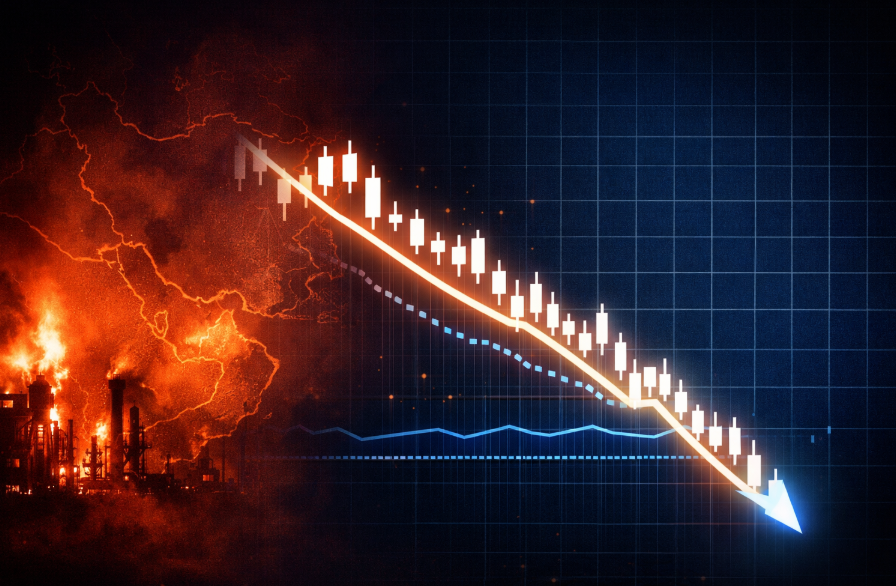
Geopolitics vs Fundamentals: Why Markets Are Falling Faster Than Earnings
Introduction
Global equity markets are currently undergoing a sharp correction, driven not by a collapse in corporate performance, but by an escalation in geopolitical risks—most notably tensions across the Middle East and the resulting surge in energy prices.
This divergence between market price action and underlying fundamentals is creating a critical question for investors:
Are markets accurately reflecting future risks, or overreacting to near-term uncertainty?
The Nature of the Current Sell-Off
The ongoing decline is best understood as a macro-driven repricing event, rather than a fundamentals-led downturn.
Three key forces are driving sentiment:
- Geopolitical escalation → Increasing uncertainty around global energy supply chains
- Energy price shock → Oil and gas price spikes feeding into inflation expectations
- Monetary policy repricing → Markets reassessing the timing and scale of interest rate cuts
Importantly, these factors are exogenous—originating outside the corporate and financial system.
Why Markets React Faster Than Earnings
Financial markets are inherently forward-looking and tend to price in risk well before it materializes in earnings.
There are three structural reasons for this disconnect:
1. Risk Premium Expansion Happens Instantly
When geopolitical uncertainty rises, investors demand a higher equity risk premium.
- This leads to multiple compression (P/E ratios fall)
- Even if earnings expectations remain stable, valuations decline
In simple terms: Prices fall not because companies are earning less—but because investors are willing to pay less for those earnings.
2. Algorithmic and Institutional De-Risking
Modern markets are heavily influenced by:
- Quantitative strategies
- Risk-parity funds
- Systematic de-leveraging
These participants react to volatility and macro signals, not just company fundamentals.
Result: Broad, indiscriminate selling across sectors—regardless of individual company strength.
3. Narrative Shifts Drive Short-Term Flows
Markets are highly sensitive to macro narratives:
- “Rate cuts are coming” → bullish
- “Inflation may rise again” → bearish
The recent shift—from expected monetary easing to renewed inflation concerns—has triggered rapid repositioning.
This narrative-driven behavior often overshoots reality in the short term.
Fundamentals: More Resilient Than Market Signals Suggest
Despite the volatility:
- Corporate earnings expectations have not seen material downgrades yet
- Balance sheets in many sectors remain strong and well-capitalized
- Demand conditions, while moderating, are not collapsing
This indicates that current price action is being driven more by uncertainty and risk aversion than by actual deterioration in business performance.
The Role of Energy: Catalyst, Not Collapse
The spike in oil and gas prices is central to the current sell-off—but it is important to contextualize its impact:
- Energy shocks tend to be cyclical and self-correcting
- High prices incentivize increased supply and suppress demand
- Governments often intervene through strategic reserves and policy measures
While sustained energy inflation could pressure margins and growth, the current phase reflects risk anticipation, not confirmed economic damage.
Historical Perspective: A Familiar Pattern
Periods of geopolitical stress have historically followed a consistent pattern:
- Initial shock → Sharp market sell-off
- Uncertainty phase → Elevated volatility
- Stabilization → As risks become clearer
- Recovery → Often before macro conditions fully normalize
Markets tend to bottom before the news flow improves, as forward expectations stabilize.
Implications for Investors
The current environment calls for discipline over reaction.
Key strategic considerations:
- Focus on high-quality companies with pricing power and strong balance sheets
- Avoid reacting to short-term volatility driven by headlines
- Use market dislocations to selectively accumulate undervalued assets
- Maintain a clear distinction between temporary macro shocks and structural risks
Key Risks to Monitor
While the correction appears non-structural, risks remain:
- Prolonged geopolitical escalation disrupting energy supply
- Sustained inflation leading to tighter monetary policy
- Spillover effects into consumer demand and corporate margins
These factors will determine whether the current repricing remains temporary or evolves into a broader downturn.
Conclusion
The current market environment reflects a disconnect between geopolitics and fundamentals, where asset prices are adjusting rapidly to uncertainty, while earnings remain relatively stable.
“Markets are not falling because earnings are collapsing—they are falling because the cost of risk has risen.”
For long-term investors, such phases often present opportunities disguised as volatility, provided decisions are anchored in fundamentals rather than sentiment.