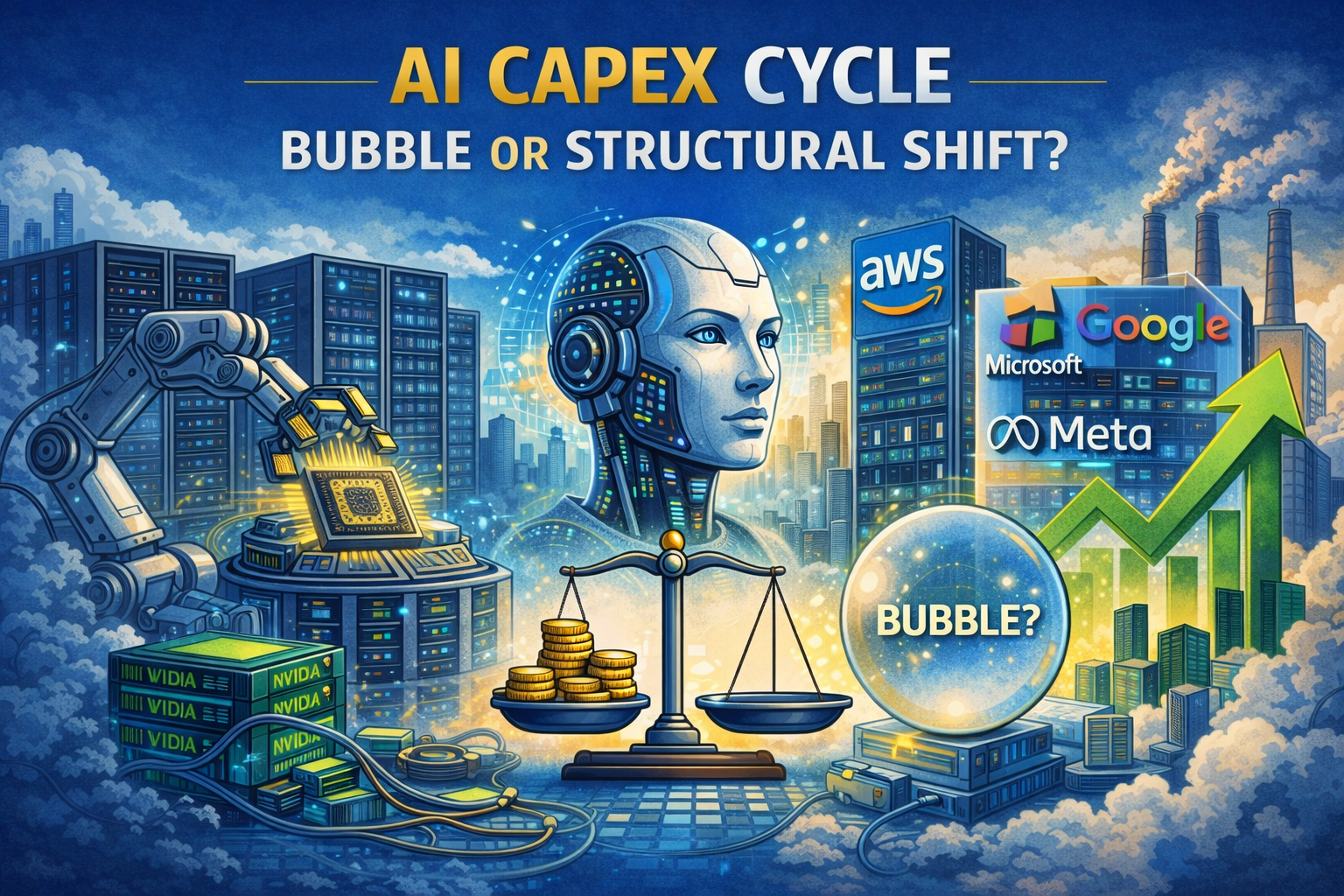
AI Capex Cycle – Bubble or Structural Shift?
Executive Summary
Artificial intelligence has triggered one of the most aggressive capital expenditure cycles in modern technology history. From hyperscale cloud providers to semiconductor manufacturers, companies are deploying unprecedented capital into AI infrastructure.
The key debate for 2026 is no longer whether AI matters. It is whether current levels of investment represent the early stage of a durable productivity supercycle — or the peak of an overextended capital cycle that could pressure returns.
Markets have rewarded AI-linked equities with multiple expansion. The next phase will test whether earnings growth justifies that optimism.
The Scale of the Investment Wave
Over the past several years, hyperscalers have sharply increased spending on:
- AI-optimized data centers
- Advanced GPUs and custom silicon
- High-performance networking infrastructure
- Power and cooling systems
- AI model development platforms
This investment cycle is distinct in both magnitude and speed. Capital intensity (capex as a percentage of revenue) has risen meaningfully across major cloud providers, while semiconductor manufacturers are expanding fabrication capacity to meet demand.
Such synchronized spending across the ecosystem is rare — and historically significant.
The Structural Bull Case
1. AI as a General-Purpose Technology
Unlike prior niche technology cycles, AI has horizontal application across industries — healthcare, finance, manufacturing, logistics, advertising, cybersecurity, and defense. That breadth increases the probability of durable monetization.
General-purpose technologies historically drive multi-decade productivity gains. If AI meaningfully enhances labor efficiency and decision automation, corporate margins could expand structurally.
2. Ecosystem Lock-In and Recurring Revenue
AI infrastructure is deeply integrated into cloud ecosystems. Enterprises building workflows around proprietary models and data pipelines face high switching costs. This may reinforce recurring revenue durability for hyperscalers.
3. Productivity and Operating Leverage
If AI enables incremental revenue growth without proportionate labor cost increases, operating leverage could improve. In that case, near-term capex would represent front-loaded investment in a long-duration earnings stream.
In this scenario, today’s spending resembles the early buildout of the internet — capital-intensive initially, but transformative over time.
The Bubble Risk Argument
History urges caution. Periods of rapid capital deployment often precede return compression.
1. Return on Invested Capital Pressure
Elevated capex leads to higher depreciation and amortization expenses in future years. If AI monetization does not scale proportionately, free cash flow conversion could weaken.
The critical question is whether incremental ROIC exceeds the cost of capital over a full cycle.
2. Competitive Oversupply
When multiple firms engage in aggressive infrastructure expansion simultaneously, excess capacity can emerge. If AI computing power becomes commoditized, pricing power may erode.
The telecom and energy sectors offer precedents where heavy infrastructure buildouts led to periods of subdued shareholder returns.
3. Semiconductor Cyclicality
The semiconductor industry remains structurally cyclical. Periods of shortage and pricing strength have historically been followed by supply normalization and margin pressure.
AI demand may extend the cycle, but it may not eliminate cyclicality.
4. Energy and Regulatory Constraints
AI data centers require substantial energy. Power grid limitations, rising energy costs, or regulatory intervention could slow deployment or increase operating costs.
Valuation Implications
AI-linked equities currently embed expectations of:
- Sustained double-digit earnings growth
- Margin stability or expansion
- Continued pricing power in infrastructure
In a higher-for-longer interest rate environment, valuation multiples are more sensitive to growth assumptions. Growth-duration equities are particularly exposed to shifts in discount rates.
If AI revenue scales and incremental margins expand, valuations may remain justified.
If revenue realization lags infrastructure investment, multiple compression could occur rapidly.
Key Indicators to Monitor in 2026
To assess whether this cycle is structural or speculative, investors should focus on measurable indicators rather than narrative momentum:
- Capex-to-revenue trends
- AI-specific revenue disclosures
- Incremental operating margin contribution from AI services
- Data center utilization rates
- Free cash flow conversion
- Return on invested capital relative to weighted average cost of capital
The transition from infrastructure buildout to monetization will be the defining inflection point.
Key Indicators to Monitor in 2026
To assess whether this cycle is structural or speculative, investors should focus on measurable indicators rather than narrative momentum:
- Capex-to-revenue trends
- AI-specific revenue disclosures
- Incremental operating margin contribution from AI services
- Data center utilization rates
- Free cash flow conversion
- Return on invested capital relative to weighted average cost of capital
The transition from infrastructure buildout to monetization will be the defining inflection point.
Conclusion
The AI capex cycle represents one of the most consequential investment waves of this decade. Whether it becomes a durable productivity revolution or a capital-intensive phase followed by normalization will depend on execution discipline, monetization velocity, and macroeconomic conditions.
In 2026, the debate shifts from enthusiasm to accountability.
Markets will begin to demand proof.