
Canada’s Banking Sector Is Surprisingly Strong
A Strong Quarter in a Difficult Economy
Canada’s economy has faced plenty of uncertainty—from U.S. trade tensions and elevated household debt to a softer housing market. Yet the country’s major banks are delivering a surprisingly strong earnings performance.
Recent results from TD, RBC, CIBC, BMO, Scotiabank and National Bank show that Canada’s banking sector is benefiting from strong capital-markets activity, improving margins and resilient domestic businesses. The Bank of Canada also says the country’s large banks have become more resilient, with strong earnings and capital providing a meaningful buffer against economic shocks.
Big Banks Are Delivering Strong Earnings
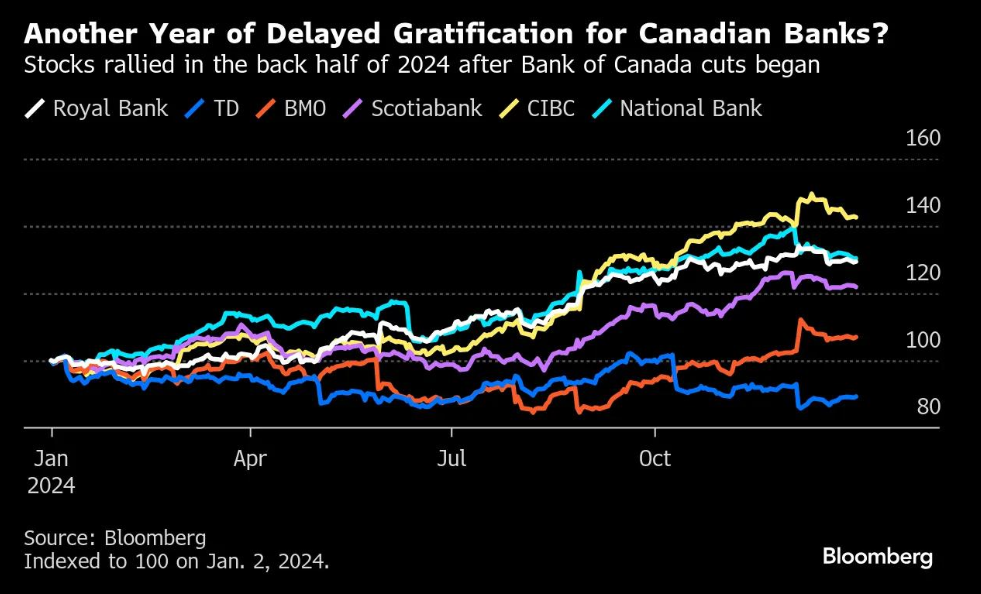
The latest earnings season has provided some impressive numbers.
RBC reported record quarterly net income of C$6.02 billion, up from C$5.41 billion a year earlier, supported by wealth management, capital markets and commercial banking.
TD Bank reported third-quarter profit of C$4.62 billion, compared with C$3.34 billion a year earlier. Its wholesale banking income jumped 87%, while its U.S. operations also delivered strong growth.
CIBC reported adjusted net income of C$2.40 billion, up 15% year over year.
National Bank also reported third-quarter net income of C$1.31 billion, up 23% from the previous year.
Capital Markets Are Doing the Heavy Lifting

One of the clearest themes across the results is the strength of capital markets.
Higher market volatility, increased trading activity and stronger dealmaking have created favorable conditions for banks’ investment-banking and trading divisions.
This matters because capital markets can provide an important earnings offset when traditional lending growth is slower.
Canadian Banking Is More Than Mortgages
A common assumption is that Canadian banks are primarily a bet on the country’s housing market.
That’s too simplistic.
The largest banks have diversified businesses spanning commercial banking, wealth management, investment banking, insurance, international operations and U.S. banking.
Scotiabank, for example, reported Canadian Banking earnings up 12% year over year and record Wealth Management earnings, while its international business also grew.
That diversification helps explain why the banks can perform well even when parts of the Canadian economy remain under pressure.
Strong Capital Provides a Buffer
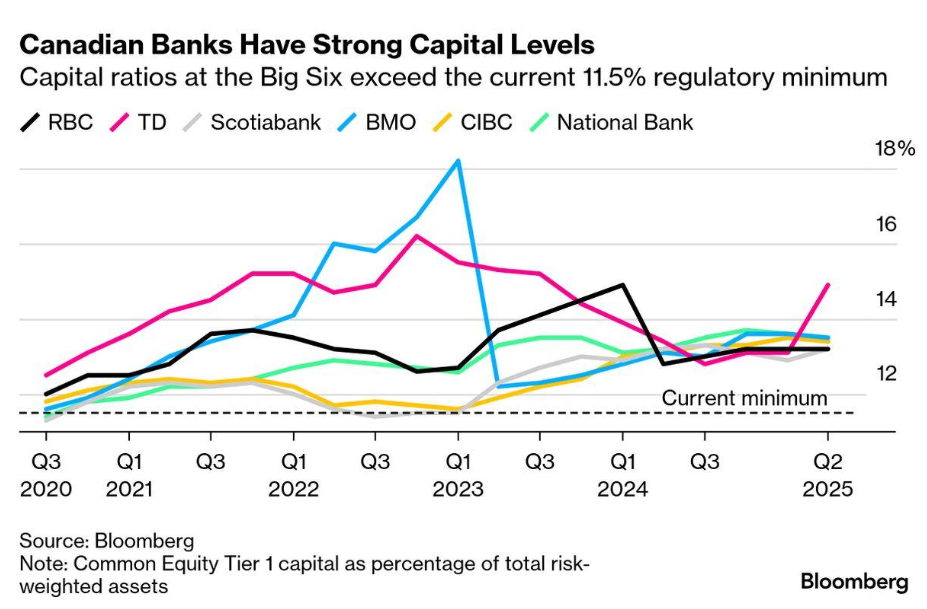
The strength of Canadian banks isn’t only about earnings.
The Bank of Canada says large Canadian banks remain in solid financial health, with high levels of capital, robust earnings and good access to funding. The central bank also notes that deterioration in corporate credit performance has stabilized.
That gives the sector an important cushion if economic conditions deteriorate.
But Valuations Are the Catch
The strong earnings story does not automatically mean Canadian bank stocks are cheap.
Canadian bank shares have already rallied significantly in 2026, and valuations have moved above historical averages. Reuters reported that bank stocks were trading around 15 times forward earnings, their highest valuation since 2010.
This creates a more difficult investment question:
Can earnings continue growing fast enough to justify today’s prices?
What Could Go Wrong?
The biggest risks remain economic rather than operational.
A weaker Canadian labour market could increase loan losses. Prolonged U.S.-Canada trade tensions could hurt businesses and investment. Elevated household debt also remains a vulnerability.
The Bank of Canada warns that trade uncertainty and geopolitical risks could eventually lead to higher credit losses, even though banks currently have substantial buffers.
What Investors Should Watch
For investors considering Canadian bank stocks, several indicators will matter:
- Loan growth
- Credit losses and provisions
- Net interest margins
- Capital-markets revenue
- Return on equity
- Dividend growth
- Valuation
Strong earnings are encouraging, but the next stage of the story will depend on whether profitability remains strong as economic conditions evolve.
Conclusion
Canada’s banking sector is proving more resilient than many investors might have expected.
Strong capital positions, diversified businesses and powerful capital-markets franchises are helping the major banks navigate trade uncertainty and a challenging domestic environment.
However, the sector’s biggest strength may also create its biggest risk for new investors: expectations are now high.
The opportunity may therefore be less about simply buying Canadian banks and more about identifying which institutions can continue growing earnings and returns without requiring ever-higher valuations.