
Small-Cap Stocks vs Large Caps: Is the Leadership Finally Changing?
The Market Leadership Question
For much of the recent market cycle, large-cap companies have dominated U.S. equities. Their stronger earnings, balance sheets, and access to capital have helped them outperform smaller companies.
But the environment may be changing. If interest rates decline, financing conditions improve, and economic growth broadens, small-cap stocks could have an opportunity to close the performance gap.
The question for investors is whether this represents a temporary rebound—or the beginning of a longer-term rotation.
Why Large Caps Have Led

Large-cap companies typically have greater access to capital, diversified revenue streams, and stronger balance sheets. These advantages become particularly valuable when borrowing costs are high or economic uncertainty increases.
That has helped large companies attract investors seeking stability and predictable earnings, while many smaller businesses have faced higher financing costs and weaker demand.
The Small-Cap Opportunity
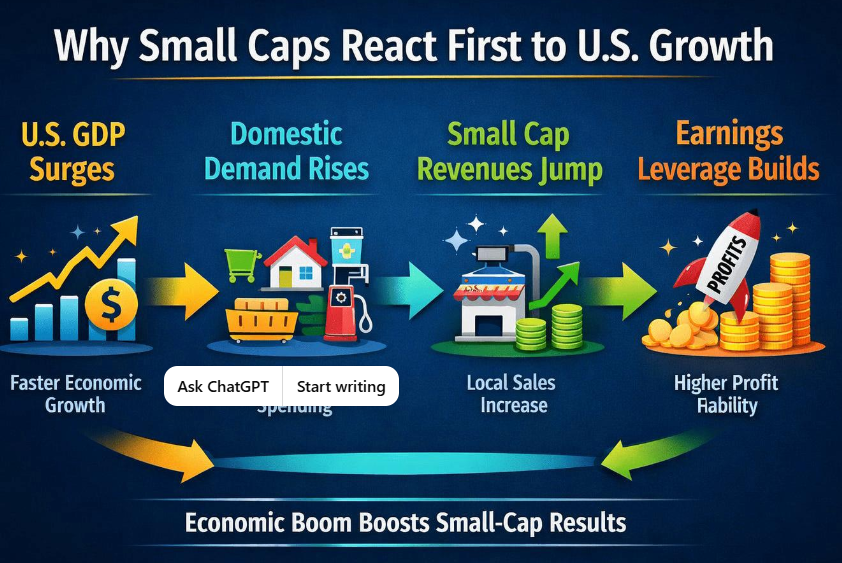
Small-cap companies can offer something large caps often cannot: greater sensitivity to an improving domestic economy.
Many smaller businesses generate most of their revenue inside the United States. If consumer spending, business investment, and economic activity strengthen, their earnings can potentially improve at a faster rate.
However, that opportunity comes with greater financial and operational risk.
Is the Performance Gap Narrowing?
A sustained small-cap rally would likely require more than a change in investor sentiment.
Lower interest rates could reduce borrowing costs, while stronger economic growth could improve revenues and profitability. If both occur simultaneously, smaller companies may benefit disproportionately.
But investors should be careful about interpreting short-term outperformance as proof of a structural regime change.
Interest Rates Could Be the Catalyst

Interest rates are particularly important for smaller companies because they tend to rely more heavily on external financing.
Lower borrowing costs can improve cash flow, reduce refinancing pressure, and make expansion projects more attractive. This creates a potential tailwind for small-cap valuations.
However, rate cuts caused by a weakening economy would be a different story. If the Federal Reserve cuts rates because growth is deteriorating sharply, smaller companies could still struggle.
Valuation Matters
The small-cap opportunity is not simply about buying smaller companies.
Some small-cap stocks trade at attractive valuations because investors are discounting weak earnings, high debt, or poor competitive positioning. Others may deserve their discounts.
Investors should therefore focus on free cash flow, debt levels, profitability, competitive advantages, and earnings growth rather than market capitalization alone.
Where Could Small Caps Benefit?

Potential beneficiaries include industrial companies, construction businesses, regional financial institutions, consumer companies, and specialized manufacturers.
These businesses could benefit from stronger domestic demand, infrastructure spending, reshoring, and improving credit conditions.
Still, sector selection remains critical because the small-cap universe contains a wide range of companies with very different financial profiles.
The Risks Investors Shouldn’t Ignore
Small caps are not automatically the next market winners.
They generally have greater exposure to economic slowdowns, higher financing costs, weaker liquidity, and company-specific risks. A weaker-than-expected economy could therefore hurt small caps more severely than established large-cap companies.
For this reason, a rotation toward small caps should be viewed as a selective opportunity rather than a blanket signal to abandon large caps.
What Investors Should Watch
The potential shift in market leadership will depend on several factors:
- Interest rates: Lower financing costs could support smaller companies.
- Economic growth: Stronger domestic demand would benefit economically sensitive businesses.
- Credit conditions: Easier access to financing could reduce balance-sheet pressure.
- Earnings growth: Small caps need improving fundamentals to sustain a rally.
- Valuations: Attractive starting valuations can provide a margin of safety.
Conclusion
The dominance of large-cap stocks may eventually give way to broader market participation, particularly if interest rates decline and economic growth remains resilient.
But the argument for small caps should not be based solely on the idea that they have “underperformed for too long.” Some companies are cheap for good reasons.
The more compelling opportunity may lie in high-quality small-cap businesses with strong balance sheets, improving cash flows, and sustainable competitive advantages.
If those fundamentals improve alongside easier financial conditions, the next phase of the market could look very different from the last one.